
Jidi Majia 吉狄马加
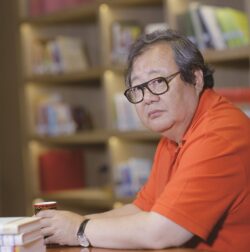 One of China's leading contemporary poets, Jidi Majia is the current Nuosu (Yi ethnic minority) Poet Laureate. His poems have been translated into nearly forty languages, and almost one hundred volumes of his poetry in translation have been published around the world. He serves as the Poetry Director of the Chinese Writers Association.
His major collections include Song of First Love, Eagle Wings and the Sun, Identity, Flames and Words, From the Snow Leopard to Maykovsky, Twenty Sonnets for My Mother, The Poems of Jidi Majia, and I, Snow Leopard, among others. He is a recipient of China’s third Modern Poetry Collection Award, the Guo Morou Literature Award, the Zhuang Chongwen Literature Award, the Sholokhov Literature Memorial Award, the Rougang Poetry Award, the People’s Literature Prize for Poetry, the October Prize for Poetry, the Chinese PEN Chinese Poetry Award, the South African Mkiva Humanitarian Award, the HOMER European Medal of Poetry and Art, Romania’s Contemporary People’s Excellence in Poetry Award, the Bucharest Urban Poetry Award, the Janitsky Literature Award in Poland, the Silver Willow Leaf Poetry Lifetime Achievement Award at King’s College in Cambridge, the Tadeusz Michinski Expressionist Phoenix Award in Poland, the Zygmut Krasinski Medal, the Guiyaquil International Poetry Prize, the Francisco Miranda Medal in Venezuela, and other awards.
He founded and organized the Qinghai International Poetry Festival, the Luzhou International Poetry and Liquor Conference, The Liangshan Qionghai International Poetry Week, Chengdu International Poetry Week, and other events.
About his own poetic calling, Jidi Majia writes:
A poet doesn’t choose to write poetry; one could say that from the beginning it is more a kind of destiny than a conscious endeavour. Every poet is their own world, each has a different mission. Mine, I would say, has much in common with that of William Butler Yeats. Like him, I am seen both within my own nation and by others as a distinct cultural symbol, and it’s undeniable that this dual identity, which both comes from the outside and is also rooted in my own sense of self, means that my poetry will always wander ceaselessly between reality and my own spiritual homeland. To put it more directly, though my poetry stems from the Yi culture I know well, it is never a rejection of the light cast on it by other civilisations, owing to our universal humanity. As I’ve put it before, ‘The firepit of the Yi people: the centre of the world, an enormous circle.’ By this I mean to emphasise that we are part of humanity, we have never left the centrality of language’s domain. Poetry cannot change its nature as the ultimate adventure of language. Only the indefinable possibilities inherent in language can create the miracle that is poetry. I’ve always believed that climbing resolutely up the ladder of language is the only way to reach that city of light: the metaphysical, the infinite, which pulls at us, seemingly within reach yet always just beyond our grasp.