
Li Shaojun 李少君
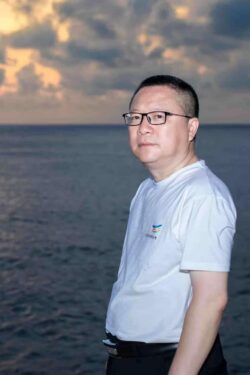 Born in 1967 in Xiangxiang, Hunan Province, Li Shaojun graduated from Wuhan University in 1989 with a degree in journalism. His major collections include The Nature Collection, The Grassroots Collection, The Sea and Sky Collection and One Ought to Say Something about Spring, among others. He is regarded as a ‘nature poet,’ and his work explores themes such as the ‘grassroots spirit’, the relationship between poetry and the poet, and the philosophical concepts of xinxue and jingjie. He has served as editor-in-chief of Tianya, and is currently chief editor for Poetry Periodical, China’s premier poetry journal on the national level.
On his philosophy of poetry, Li Shaojun writes:
Writing poetry is a form of xinxue 心学—a study of subjective consciousness. The creative process begins in one’s heart; a poem seeks to understand, integrate, draw connections about the world, link people’s inner worlds. Writing in this way is a form of self-cultivation; it strives toward transcendence and elevation, toward experiencing meaning, creating a world, finding peace.
When I say poetry is xinxue I mean that after a poem is written, it speaks heart to heart, leading others to feel emotion or experience understanding, to achieve insight and find peace of mind.
Poetry is also the study of emotion, qingxue. It is a textualisation of emotion, emotion embodied in words, just as art is a formalisation of emotion, an emotion embodied in form. Poetry stores feelings.
Poetry creates a jingjie 境界 – a higher realm of meaning, a level or perspective for understanding the world. It is the spirit’s taste, a hierarchy of the soul. In poetry, a poet creates a world of meaning vested with emotion.