
Theatre Review: Hot Pot
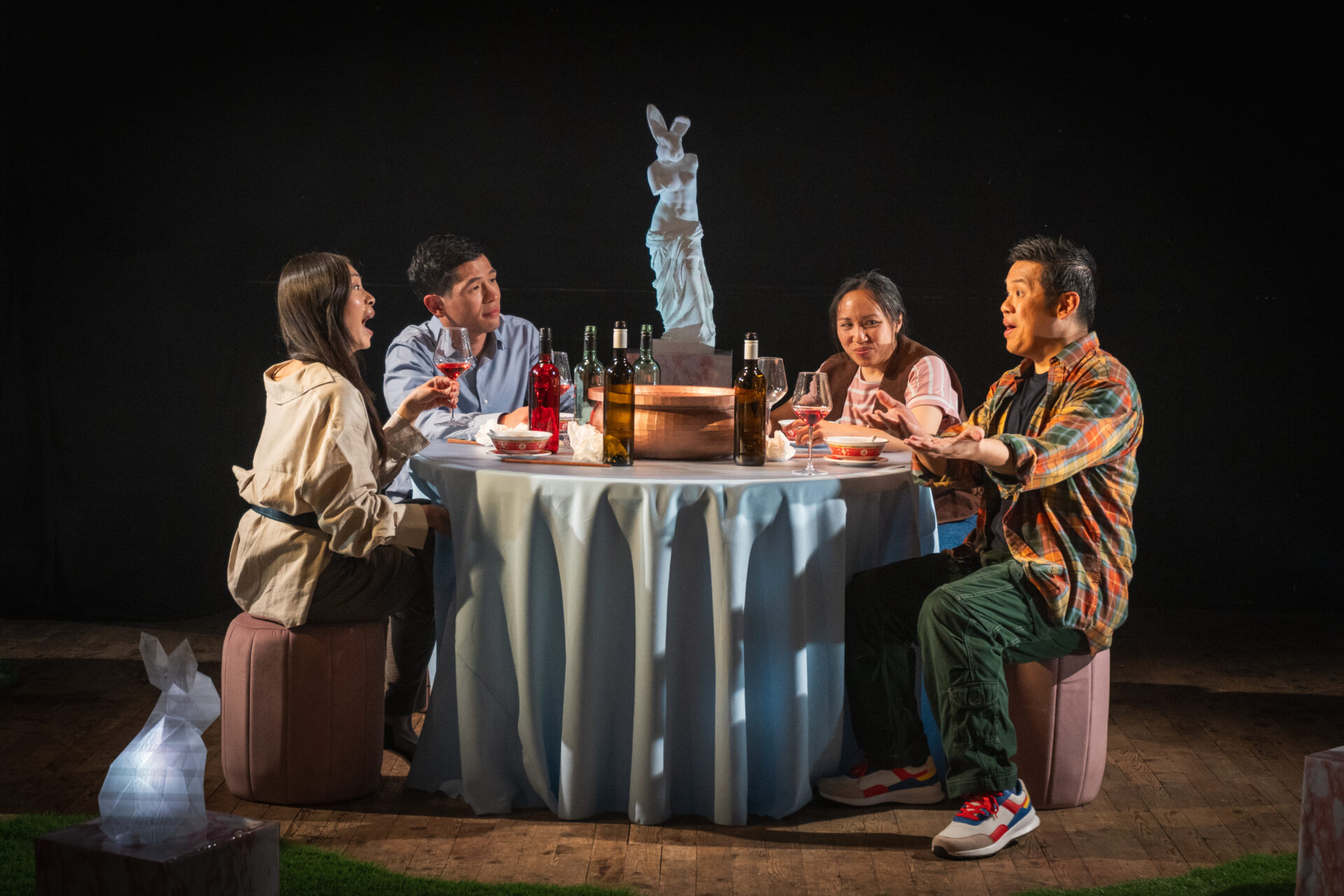
"Hot Pot"
Stage@Leeds, 26th June 2026, supported by The Leeds Centre for New Chinese Writing
Have you ever eaten hot pot, the traditional Chinese meal that brings people together to cook, eat, and share stories? More than simply a dish, hot pot is a social ritual in which conversations move naturally between memories of the past and experiences of the present. Hot Pot captures this process vividly through the reunion of four friends: Ming (a Chinese gay man who married a woman), Mei (a married Chinese woman), Tao (a Chinese gay man preparing to marry an English man), and Lin (an unmarried Chinese woman). As they gather around the hot pot, they revisit old memories while revealing the complexities of their present lives.
Produced by Auka Productions and written by Professor Hongwei Bao, a distinguished scholar of East Asian Queer Studies in the UK, Hot Pot presents a thought-provoking and inclusive story that resonates with both Chinese LGBTQ+ and heterosexual audiences. Gay audience members may recognise the emotional and cultural challenges surrounding coming out, while women may reflect on the blurred boundaries between sisterhood and romantic intimacy. Heterosexual audiences may also identify with the tensions between love, marriage, and the cultural expectation of having children. Rather than presenting these experiences separately, the play demonstrates how different forms of love, desire, and family responsibility intersect within contemporary Chinese society. The play is rich in cultural symbolism while remaining accessible to audiences unfamiliar with Chinese language and culture. Small amounts of Chinese dialogue are carefully integrated with contextual clues that allow non-Chinese-speaking audiences to follow the story with ease. In one memorable scene, a character quotes the Chinese proverb 不孝有三,无后为大 ("Of the three forms of unfilial behaviour, the greatest is leaving no descendants") before immediately repeating its meaning in English. This smooth transition preserves the cultural significance of the proverb while ensuring that its meaning is accessible to the audience. One of the production's greatest strengths is the close collaboration between scenography, sound, and lighting, all of which reinforce the play's cultural symbolism and emotional depth.
The sound design is particularly effective. Between each scene transition, the audience hears the sound of boiling water. On one level, this naturally represents the simmering hot pot that remains at the centre of the story. On another, I interpreted the boiling as a metaphor for the emotional pressure experienced by queer individuals who feel unable to come out because of traditional Chinese family expectations. The continuous boiling evokes a feeling of being under constant pressure, reflecting the tension between personal identity and patriarchal cultural values.
The scenography also offers subtle yet meaningful intercultural details. Instead of serving traditional Chinese spirits with the hot pot, the characters drink red wine, reflecting the production's British setting while maintaining its Chinese cultural context. At the same time, traditional Chinese drinking etiquette and drinking games, such as 划拳 (hua quan), are preserved. This combination creates an engaging intercultural dialogue, allowing Western audiences to connect with familiar elements while introducing them to the cultural traditions and social expectations that shape the characters' lives. At the centre of the stage stands a statue of Venus wearing rabbit ears. This striking image combines two powerful cultural symbols: the Rabbit God, the Chinese deity associated with same-sex love, and Venus, the Greek goddess of love. The production deliberately uses the familiar armless version of the Venus de Milo. Here, the broken arms become more than an archaeological feature; they symbolise the struggles, constraints, and obstacles experienced by sexual minorities. Through this intercultural image, the production suggests that while love is universal, the freedom to express it is not.
The Rabbit God motif is further developed through the lighting design. Rather than relying solely on conventional stage lighting, the production incorporates four rabbit-shaped floor lamps whose colours shift in response to the emotional atmosphere of each scene. These subtle changes not only reinforce the symbolism of the Rabbit God but also create an intimate emotional connection between the audience and the characters' inner lives.
The most moving moment of the performance is the recurring question posed by each character: "Are you happy?" This simple yet profound question becomes the emotional heart of the play. It extends beyond the experiences of LGBTQ+ communities and speaks to everyone in the audience. Whether constrained by expectations surrounding sexuality, gender, marriage, family, or love itself, each audience member is invited to reflect on their own pursuit of happiness. In this way, Hot Pot becomes more than a story about queer identity in contemporary China; it is a deeply human exploration of love, belonging, cultural expectation, and the universal desire to live authentically.
reviewed by Xunnan Li, 26/6/26
*****************************
If the above review has piqued your interest, read more about Hongwei Bao's work, including the short story, "Reunion", which was adapted into this play, in our April bookclub. From a previous feature on our site you can also read some of Hongwei's poetry about the Rabbit God. We are very grateful to Hongwei for sharing so much of his work so freely with us.