
Translator's Notebook: Imagery and Cultural Associations in Poetry
Zheng Wanqi (郑婉琪) is an MA student currently enrolled in the English Literature course at the School of English, University of Leeds. She participated in ‘Lines of Transport: The Chengdu-Leeds Poetry Exchange’ (2026) as a student co-translator, working with Austin Woerner to translate poetry by Bai Hua, Gong Xuemin, Xiang Yixian, Li Shangyu and others into English.

One of the things I love most about translating poetry is the challenge of processing complex or abstract imagery simultaneously in two languages. That process can be quite exciting because through it one can clearly see where cultural differences and diversity lie. Sometimes a single word carries so many connotations or allusions that it it seems impossible to translate effectively; one might feel the need to add a footnote, or find a word in the target language that achieves a similar effect even if it refers to something physically different.
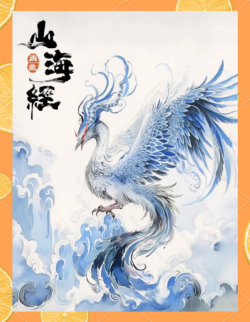
Qingniao
For example, the poem 'Six Dynasties Style' by the contemporary poet Xiang Yixian contains the image of the qīngniǎo ‘青鸟’. Literally this means ‘blue bird’ – but it is not the animal referred to by the English word ‘bluebird’. In classical Chinese mythology, the qingniao is the messenger bird of the Queen Mother of the West (西王母), believed to carry divine messages between gods and humans. Over centuries, it has become a rich poetic symbol for communication across great distances, longing, and the hope of being heard despite separation. Unlike a simple nature image, this bird is layered with mythological meaning and literary echoes, making it especially hard to translate. There is no direct equivalent in English. This is not because of any fixed, absolute qualities of the languages themselves but because different literary traditions have developed different clusters of imagery and symbolic shorthand. In translation, though, sometimes the most elegant solution is the simplest one. We opted to translate qingniao simply as ‘magic bird’, keeping the word simple and functional and letting the depth and resonance come through in other parts of the poem.
Another example is more elusive. In ‘A Faint Light’ by Li Shangyu, the final line states that the light becomes kongguang 空旷. In Chinese, this word carries multiple meanings. Kong 空can mean empty, with nothing inside, but it can also convey a paradoxical sense of fullness, influenced by Buddhism, where kong denotes the fluid, ever-changing nature of all things. A well-known Buddhist axiom goes, ‘emptiness is substance, substance is emptiness ‘空即是色,色即是空,’ meaning that all the tangible, physical phenomena we see or touch (色se, colour, i.e. substance, what can be perceived by the senses) — are ultimately dependent on shifting causes and conditions; their very nature is kong空(emptiness). Meanwhile, kuang旷 relates both to a vast space and to a long span of time. Together, they describe wide-open spaces, and convey a sense of expansiveness and possibility. So how to translate the line in a way that captures the vividness of the image as well as its emotional tenor? In the end, we settled on: ‘the light opens up into an empty space.’ We used the phrase ‘opens up’ to convey a sense of motion and unfolding, ‘space’ to suggest the sense of a field, and the adjective ‘empty’ — leaving it up to the reader to decide what might fill it.
I used to think of poetry as something sublime, complex, and far out of reach. However, after translating for Lines of Transport: The Chengdu-Leeds Poetry Exchange, I’ve come to realise that poetry is an art of conciseness, talking about the beautiful things in our everyday lives right here, right now. Now, when I read a poem, I try to appreciate it from the poet’s perspective: I wonder how they capture poetic moments and find beauty in ordinary life, how they use the simplest language to express multi-layered feelings, how they construct their poems, and what they are hiding beneath seemingly simple lines. Reading a poem feels like being an adventurer with a map in hand, trying to find hidden treasure. Once I’ve found it, I transport it back to my cave and start designing my own treasure map in another language — coding it with my own interpretation. And when I’m done, I spread out the maps and invite people into my cave to search for the treasure themselves.