
Theatre Review: Ballad of Mulan by Red Dragonfly Productions
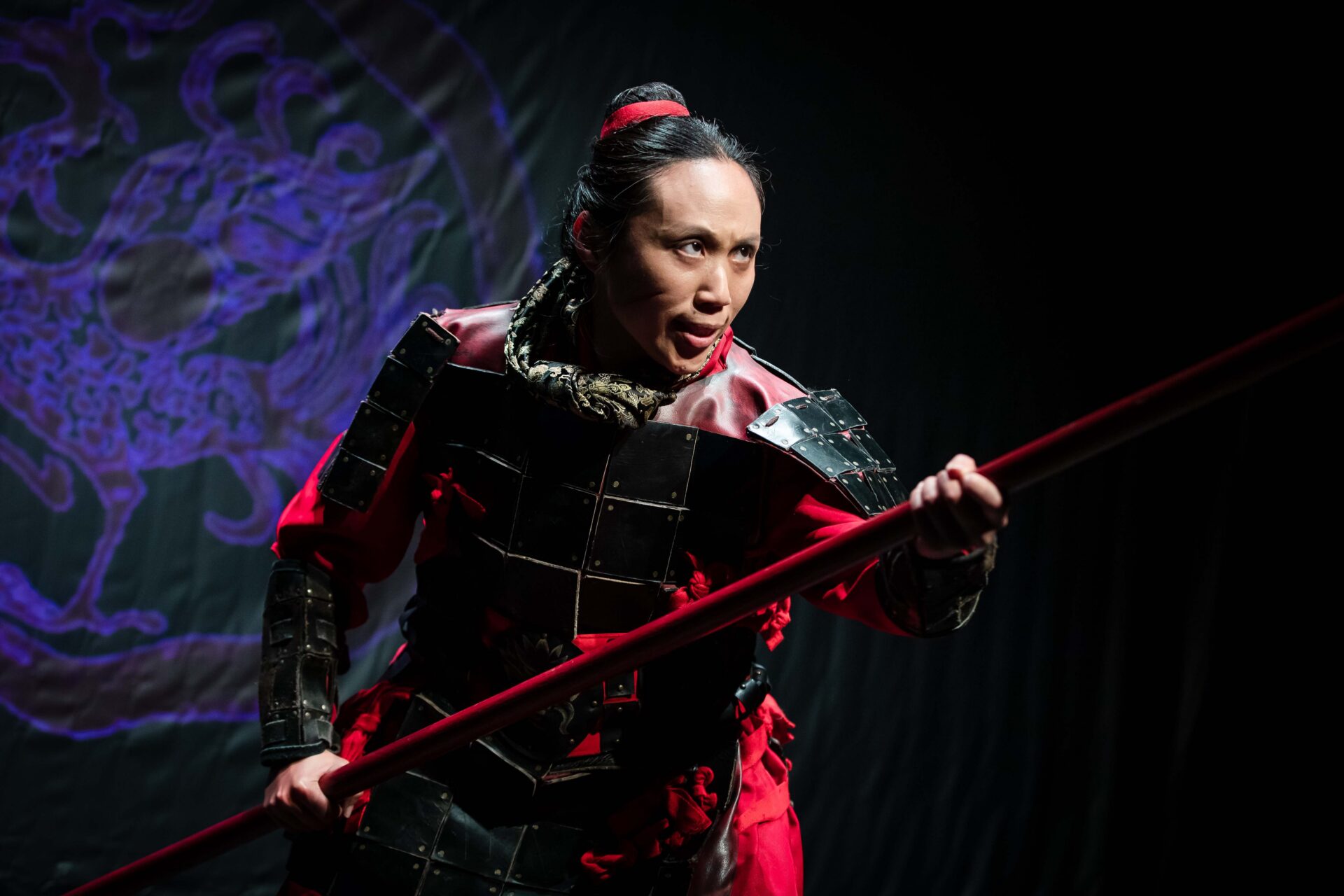
York Theatre Royal, 11th September, 2026, Dr Xunnan Li
Monologue and soliloquy are two important modes of solo acting in theatre. In performance, monologue can represent the sympathy and judgement of the director and playwright through a character’s solo speech, while soliloquy is not merely self-address, but can become a moment in which character, actor and audience seem to be having a conversation around the same table. James Hirsh’s study of soliloquy usefully distinguishes between speech addressed to playgoers, self-addressed speech, and interior monologue, demonstrating the complex relationship between character, performer and audience created through this theatrical form. The Ballad of Mulan, commissioned by and performed by Michelle Yim, from Red Dragonfly Productions, spotlights such a wonderful in-betweenness of monologue and soliloquy. These two modes of acting are used consecutively to form a discussion of womanhood through Chinese traditional culture.
Entering the theatre studio, the audience encounters traditional Chinese flute music accompanied by the minimalist and symbolic scenography of one chair, one short wooden table and a clothes rack, recalling the conventionalisation of Chinese traditional theatre staging. Such simplicity has a long history in Chinese theatre, where an almost empty stage and a limited number of objects, particularly tables and chairs, can symbolically construct different theatrical environments rather than realistically reproduce them. All that remains is a sword that symbolises the story of Mulan, a woman who cross-dresses as a man to join the army as a soldier. The production therefore immediately recalls Mulan Ci 木蘭辭 The Ballad of Mulan, the anonymous verse/poem probably originating in the Northern Wei period, which provides the earliest surviving literary version of Mulan’s story. However, different from popular Disney’s animated Mulan (1998) and Jingle Ma’s Mulan: Rise of a Warrior (2009), which incorporate the developing attraction between Mulan and Captain Li Shang, Yim’s version puts its focus firmly on a feminist expression of womanhood.
The first act leads the audience into a nervous and brutal description of war, where Mulan describes the actions of the battlefield through an affective monologue that powerfully arouses the emotions of the audience. Then, between the acts, four lines from the traditional folk poem Mulan Ci are used to introduce the next section of soliloquy. Here, Mulan steps away from the battlefield and talks to herself while, at the same time, seeming to talk directly to the audience about her post-war gender identity, gender inequality, gender stereotypes, and the complications of gender norms in ancient China that remain persistent in the contemporary world and resonate interculturally with gender issues in Britain. The whole hour-long performance keeps this consecutive movement between Mulan’s monologues describing her experiences on the battlefield and her soliloquies critiquing gender issues deeply connected to contemporary society from a feminist perspective. In one of these soliloquies, Mulan recalls being bullied by a boy and how, as a teenage girl, she first realised the importance of gender equality and the power of protest. When bullying, gendered humiliation and conventional patriarchal gender norms become locks and cages imposed upon girls and women, Mulan asks, “Would I fight or would I run?” The answer is clear. Mulan fights not just for herself, but for women who are oppressed; and she fights as a soldier for her nation as equally as a man.
The whole performance empowers the audience through these powerful acts of soliloquy and monologue. It gradually becomes both a manifesto and a protest against patriarchy, travelling from the ancient era to the contemporary world and from Chinese territory to British soil. It treats gender inequality as a universal problem that crosses cultures and times. Importantly, this feminist reading is not something that can simply be assumed to exist within the original Mulan Ci. Tian and Laguna Mariscal (2024), for example, argue that although the final metaphor of the poem can invite a feminist interpretation, the historical text is more centrally concerned with filial and patriotic duty. Yim’s production therefore does something more active: it takes this inherited cultural text and deliberately rearticulates it through a contemporary feminist voice.
The performance ends with Mulan reading the final lines of Mulan Ci, culminating in “安能辨我是雄雌?”, literally asking how one could distinguish male from female. In the traditional sentence, “雄” (male) comes before “雌” (female), and this male-female sequence is also projected on the screen. In the performance, however, Mulan, played by Michelle Yim, deliberately reverses it to ask: “Who could distinguish female from male?” This apparently simple reversal becomes a powerful artistic expression. By placing the female before the male, the performance does not merely repeat the classical text but intervenes in it, re-emphasising its protest against gender inequality and bringing the feminist argument of the whole performance to its final and most concentrated expression.