
Hongyu Jasmine Zhu 朱弘昱, schools translation competition winner
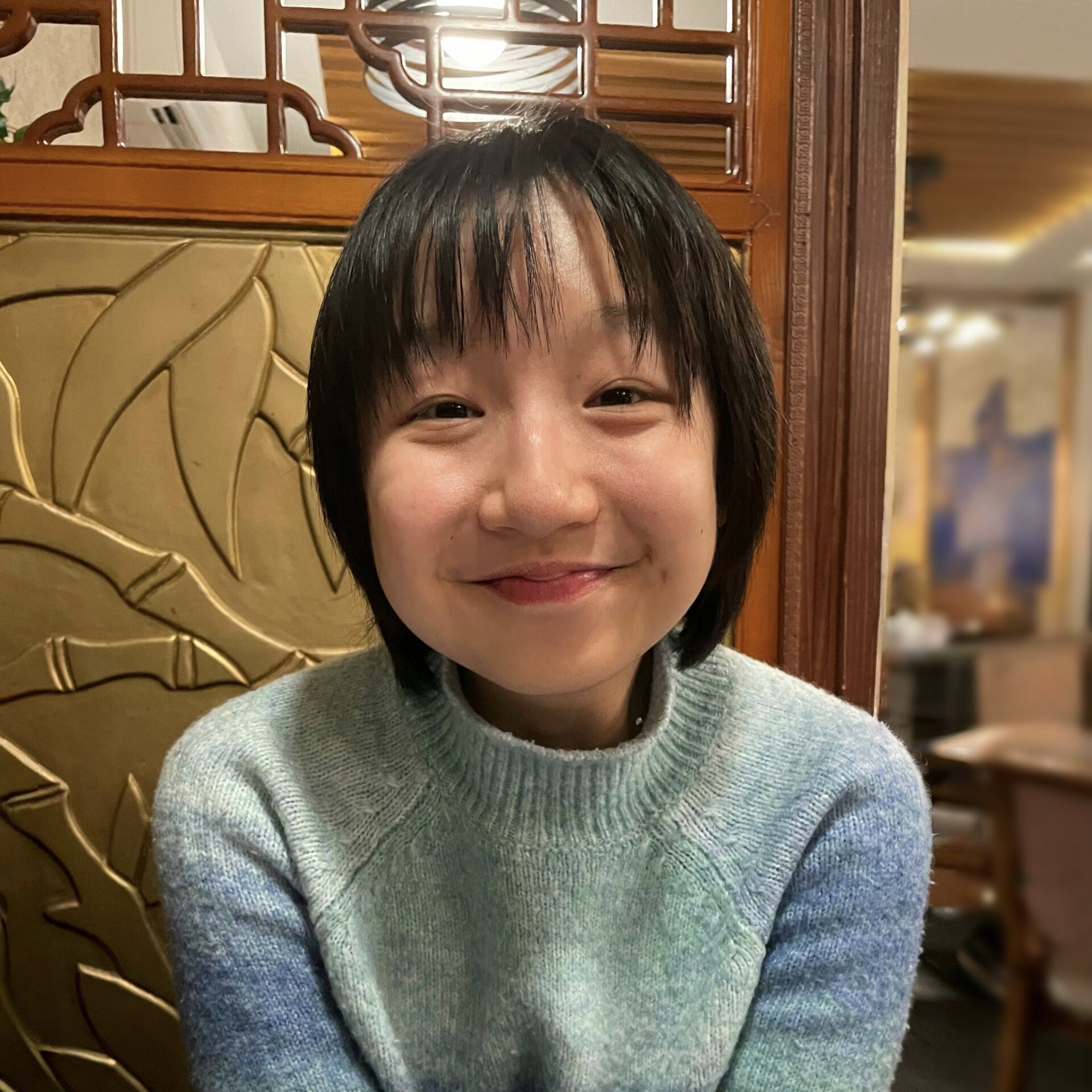
We are delighted to publish an interview with the winner of the 8th Bai Meigui Translation competition, and the 3rd competition open exclusively to secondary school students. The challenge was to translate into English a complete picture book by the Taiwan author and illustrator Zhou Jianxin, 周見信, our bookclub author for April 2025. The prize was to be mentored by award-winning children's translator Helen Wang, and to have the translation published in full as a picture book, by Balestier Press. You can read the original and Jasmine's translation on our bookclub page, but do remember to purchase the book too!
- Thank you so much, Hongyu Jasmine, for answering our questions. How did you hear about this competition and why did you decide to enter?
I came upon the competition while surfing online for recent picture books written in Chinese. Around that time, a few dreams were just beginning to take root in me: to become a literary translator, to write for young readers, and to open a reading room brimming with picture books from around the world, for children and “big children” alike to huddle, read, and play… Bai Meigui was like an invitation for all these dreams to play together for the first time—and that felt very precious.
- How did your dreams in literary translation and children’s literature come about?

Little Jasmine reading a picture book (Photo supplied by Jasmine)
I remember many intimate hours spent with my mama, reading picture books—mostly in Chinese, some in English—punctuated by her reactions spoken in our Sichuan dialect.
That was the beginning of my joy in words. During Thanksgiving break in 2021, I stayed in an Airbnb cottage and the host happened to be a children’s book writer. I picked up Kafka and the Doll from her sunny shelf—and it moved me so deeply that I began reading picture books again for the first time in over a decade.
I’ve grown up as a little language nerd; even hopping between dictionary entries was a game I could play with myself for hours. In retrospect, translation had been with me from the very start—since those early readings with my mama and all throughout my language-learning adventures. But it wasn’t until I studied in the U.S. that I realized translation had always been an undertone of my life.
- Had you done much literary translation beforehand?
A little bit. In 2021 I was part of the Chengdu Philharmonic Choir, and we were singing “Rivers of Light”, a choral poem composed by Ēriks Ešenvalds. On a whim, I started translating the English lyrics into Chinese, and that opened up a whole new world—negotiating each musical sound, poetic leap, breath, and rest. For the first time, I sensed that translation was anything but a linear crossing of borders. So tangibly anchored, word by word, I felt I’d found a friend—as a somewhat confused international student living between languages and homes.
Later that summer, I read Taiwanese writer 甘耀明 Kan Yao-ming’s novel 《邦查女孩》 The Pangcah Girl, after my mama’s fervent recommendation. Turning to its last page, I remember thinking to myself: One day, I want to introduce this story to English readers! My mama was excited too: “Why don’t you start now?” So I did—and I was very lucky to receive the 2022 ALTA Travel Fellowship with a translated excerpt from the novel.
Around then, I also translated Taiwanese writer 三毛 Sanmao’s autobiographical story 《吹兵》“Chui Bing”, which I adapted into a monologue and performed on stage. That experience sparked my thinking about translation as embodiment—and vice versa. I’ve recently returned to that memory, exploring performative possibilities to introduce the stories I translate to new audiences.
And…does translating fun, beautiful place names into Chinese while texting my family count too? Haha.
- What did you enjoy most about translating this book?
What I enjoyed most was also what made up the many happy headaches of translation: the act of returning—to the source text, to the illustrations, to earlier drafts—and asking myself what they were doing and why I’d rendered something a particular way. The process could be as tedious as deleting a comma, putting it back in, reading the line aloud sitting, standing, lying down—then deleting the comma again, and repeating that for months, until the story finally read just right, both to the eyes and to the ears.
When I was translating 《小松鼠與老榕樹》 Little Squirrel and Old Banyan, I was attending Mercersburg Academy—a high school never short of trees or squirrels. On my way to meals, to classes and afternoon activities, I’d pass them often. Translating this story made those everyday encounters feel special. I’d pause in front of a squirrel scurrying up a tree and wonder: Could they be Little Squirrel and Grampa Banyan? And right there—what treeness means, and how Little Squirrel might speak, became a little clearer to me.
- Was there anything you found particularly challenging in this book?
The expression 牽掛 (qiān guà) was especially tricky. Not to give the story away, it comes up twice, each time weighted and oriented a little differently. I’ve said 牽掛 all my life, and its associations felt so automatic that I’d never paused to consider what it is that makes it so moving. The two characters respectively mean “to pull” and “to cling”—put crudely. 牽掛 is more than remembering someone fondly, and not quite the same as worrying about them either. Isn’t it also a tug on the heartstrings? And a clinging that makes parting so hard?
Eventually, the immensity of 牽掛 suggests its own solution: since it comes up twice, I translated it twice, in different ways. Still, even now that the translation is finalized, I sometimes return to the question: what is 牽掛 to me?
Another challenge came with how Grampa Banyan uses the character “死 (sǐ)”, meaning “to die”. He utters it so effortlessly yet deliberately—like in “生命會死”—that I felt it had to be translated as is. The English I arrived at: “Life dies.” At first, it troubled me. When I showed it to people, they said it sounded awkward: “dies” isn’t a typical verb to follow “life”. But smoothing it over would mean avoiding the word “die” altogether. Turning this over for days, I decided to keep it—if it sounds strange, let it be a new way of saying that death is not after life, but part of it.
- Is there anything specific to the translation of picture books which you think might be different from translating other works?
As with any literature, there are so many ways a story might be encountered—but this feels especially true for picture books: I can imagine one being read aloud to a child at bedtime or in the cuddle nook of a children’s library, discovered by a kiddo in a kindergarten reading corner, or picked up from a bookshelf by someone who never thought they’d read picture books again (like myself a few years back).
So in translating, I made it a priority to keep the story playable and readable—while ensuring that even a simple-sounding line could lend itself to lingering thought. Both are qualities that stood out to me in Zhou Jianxin’s beautiful writing.
When we think of “books”, we tend to think of words. But in “picture books”, the picture does half the storytelling—the word “picture” literally takes up half the genre’s name! I think that gives translators a little more room to play.
For instance, in Little Squirrel and Old Banyan, there’s an endearing line Grampa Banyan says to Little Squirrel. When I tried translating every word, the English read clunky and lost its intimacy. But since one particular word was already conveyed by the illustration, I felt justified in leaving it out—and suddenly, the sentence worked. Similarly, different renderings of a line can heighten different aspects of an illustration. That, too, becomes part of the translator’s creative work.
- Has your success in this competition made you want to translate more?
Definitely! I’m especially grateful that the picture book category of the competition is open exclusively to secondary school students. That alone was incredibly empowering—it gave me, young and inexperienced as I am, the belief that I could translate too.
It was also humbling to receive encouragement from the wonderful judges—Nicky Harman, Amanda Ruiqing Flynn, and Jennifer Feeley—through the award, and to be mentored by the extraordinary Helen Wang. All of them are my role models, having each contributed profoundly to the field of Chinese literature in translation with a distinctive artistic vision. Their support made me feel that I was joining a generous, vibrant community.
Since then, I’ve only felt more drawn to translation—as both a creative practice and a lifelong calling. Looking back, my experience with Bai Meigui helped me trust that I could keep going, and that my small beginnings—in translation and in children’s literature—might one day lead somewhere.
- Have you done more translation since you entered this competition?
Yes! I’ve kept at translating excerpts from The Pangcah Girl, and recently branched out into Kan Yao-ming’s latest novel 《成為真正的人》 minBunnun, along with several of his short stories. It’s been a mostly private enthusiasm, but I’m starting to shift gears toward polishing excerpts for submission to literary journals.
I was fortunate to place second in the 2022 Comma Press Emerging Translator Prize, which gave me the opportunity to translate 石一枫 Shi Yifeng’s short story《张先生在家么》“Is Mr. Zhang Home?” for The Book of Beijing. My ongoing translation of 幾米 Jimmy Liao’s picture book 《星空》 The Starry Night also helped me receive the 2024 SCBWI Conference Translation Scholarship.
Other ongoing translation projects include several essays by 史铁生 Shi Tiesheng about his late mother, a trans-adaptation of my favorite Chinese songs, and 李潔琳 Jolin Lee’s creative nonfiction piece 《伊人在暹羅》 “They Who Left for Siam”, supported by the 在場 · 非虛構翻譯獎學金 Frontline Non-Fiction Translation Fellowship.
Like many translators, the more time I spend with this little art, the more I find it a metaphor for many things—naming translation in all kinds of quotidian moments has become part of how I would like to move through the world. I’ve even started translating poems written by my partner—as a way to perform a close reading of him:)
- Is there anything you would say to any other school students who may be considering taking up literary translation?
If you’ve found a writer or a work you love, don’t be afraid to try translating it and see what happens. As I followed the fun rabbit hole of literary translation, I discovered just how much more there is to learn—and how much trial and error is involved, especially on the publishing side of things. But the desire to share something I truly believe in has kept me going and guided me to regather myself when I felt a little lost.
Once I have a first draft, I love showing it to someone and asking what they hear in it—emotion, music, personality…free workshop opportunities right there! Perhaps you’ll find those conversations, even informal ones, enriching too. I also try to read translations side by side with their source texts to study how brilliant translators work their magic. And sometimes, just listening to translators talk about their own process or engage with translation as a space for critical reflection opens up for me new ways of seeing.
Translation to me is literary, philosophical, and deeply human. And the literary translation community is full of warm-hearted people, always humbly growing in their craft and generous in inviting others in—no matter how long they’ve been at it. If you’re even a little curious, I hope you’ll follow that instinct. It might turn into something truly beautiful.
And definitely keep an eye out for the next round of Bai Meigui—I’m really glad I did!
Thank you Hongyu Jasmine, for answering our questions, and congratulations on your success in the competition and your beautiful book. We wish you a wonderful career in literary translation ahead.